
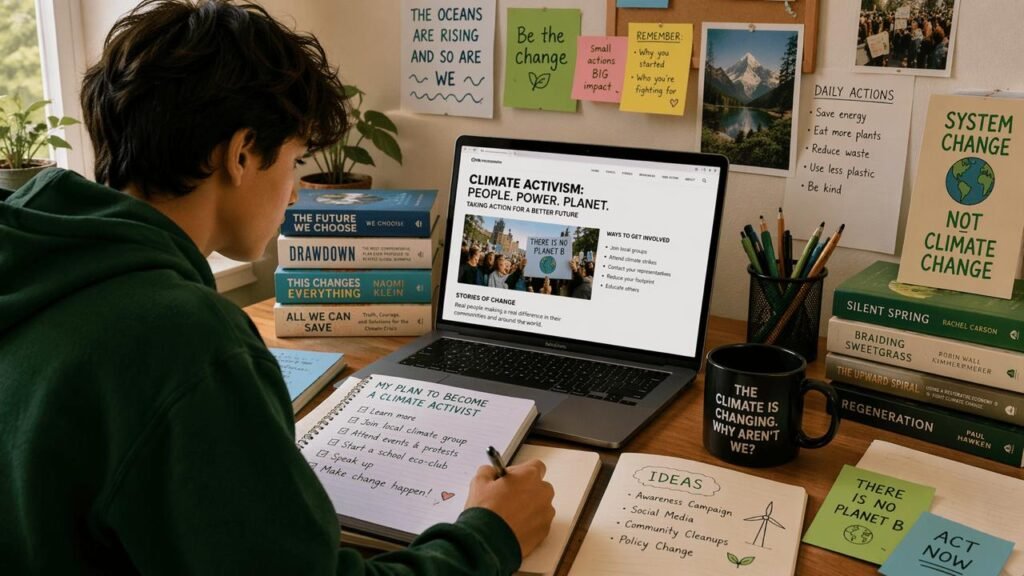
Young person at desk researching climate activism on laptop surrounded by environmental books and notes, planning their journey to become a climate activist.
You don’t wake up one day as a climate activist. You become one through a series of small decisions that gradually reshape how you spend your time, what you talk about, and where you direct your energy. If you’re reading this wondering how to make that transformation, you’re already further along than you think. The distance between climate-concerned and climate-active is shorter than it appears.
What Climate Activism Actually Looks Like
When most people picture climate activism, they imagine Greta Thunberg addressing world leaders or protesters blocking pipelines. These high-profile actions represent just one slice of a much larger movement. Climate activism in 2026 encompasses teachers integrating environmental justice into their curriculum, tech workers pushing their companies toward carbon neutrality, artists creating installations about glacier loss, and youth representatives traveling to 195 countries documenting frontline climate stories.
The diversity of climate activism is its strength. There’s no single path, no credential required, no age limit that matters. What transforms someone from concerned citizen to climate activist isn’t a dramatic moment but rather the decision to shift from passive worry to active engagement. This guide provides a clear pathway for anyone ready to make that shift, addressing the practical questions that often go unasked: Can you make money doing this work? Do you need to quit your job? Where do you even start?
What Are the Different Types of Climate Activists?
Before mapping your path into climate activism, it helps to understand the landscape. Climate activists operate across several distinct but overlapping categories, each requiring different skills and offering different entry points.
- Community organizers focus on grassroots mobilization, bringing people together for local environmental campaigns. They host meetings, coordinate volunteers, and build the social infrastructure that sustains movements over time. If you’re someone who naturally connects people and enjoys event planning, community organizing might be your lane.
- Policy advocates work within governmental and institutional systems to push for climate legislation and regulatory change. They attend city council meetings, lobby elected officials, submit public comments on environmental policies, and translate complex policy into language that mobilizes public support. This work requires patience, strategic thinking, and the ability to navigate bureaucratic processes.
- Direct action activists participate in climate marches and community forums that visibly show public demand for climate action. They create the pressure that makes policy change politically viable. This category includes everything from Fridays for Future school strikes to organized campaigns targeting specific corporations or projects.
- Climate educators share knowledge about climate science, solutions, and justice through teaching, content creation, public speaking, and workshop facilitation. They combat misinformation, build climate literacy, and empower others to engage with environmental issues thoughtfully. Writers, YouTubers, teachers, and documentary filmmakers often fall into this category.
- Innovation activists drive climate solutions through technology, business, and systems design. They develop renewable energy projects, create sustainable products, design circular economy models, and prove that climate action can be economically viable. This activism happens in startups, research labs, and corporate sustainability departments.
- Workplace activists organize within their existing jobs to push employers toward climate accountability. Through initiatives like the Employee Climate Action Network, they advocate for corporate carbon neutrality commitments, sustainable supply chains, and alignment between company values and climate reality.
Most effective activists don’t confine themselves to a single category. A climate educator might also participate in direct action. A workplace activist might volunteer with policy advocacy groups on weekends. Your climate activism will likely blend several approaches based on your skills, interests, and available time. The key is recognizing that activism takes many forms; find the ones that fit your life rather than forcing yourself into approaches that don’t.
Step 1: Find Climate Activist Role Models (But Don’t Try to Be Them)
Role models serve two crucial functions for aspiring climate activists: they prove that meaningful impact is possible, and they offer tactical inspiration you can adapt to your own circumstances. The climate movement includes activists at every age, from every continent, working across every approach outlined above.
- Greta Thunberg, now 23, remains the most recognized climate activist globally. Starting her solo school strike for climate in 2018 at age 15, she catalyzed the Fridays for Future movement that brought millions of young people into climate activism. Her accomplishments include addressing the UN Climate Action Summit, meeting with world leaders, and fundamentally shifting how global media covers youth climate voices. Importantly, Thunberg doesn’t take a salary for her activism work, donating prize money to climate causes; a model that’s admirable but not financially sustainable or necessary for most activists.
- Vanessa Nakate from Uganda emerged as a leading voice for African climate justice, founding the Rise Up Movement and using her platform to amplify stories from frontline communities often ignored in Western climate discourse. At 29, she shows how activists can center marginalized perspectives while building international influence.
- Xiye Bastida, a 23-year-old Mexican-Chilean activist based in New York, co-founded the Re-Earth Initiative and organizes with the Fridays for Future movement. Her work emphasizes the intersection of Indigenous wisdom and climate science, showing how activists can honor cultural knowledge while engaging with contemporary movements.
- Licypriya Kangujam from India began her climate activism at age 8, making her one of the youngest prominent climate activists. By age 14, she had addressed world leaders and pushed for climate education in Indian schools, proving that age is no barrier to meaningful advocacy.
Among famous Greenpeace activists, Kumi Naidoo served as Executive Director and brought decades of experience in social justice movements to environmental campaigns. Jennifer Morgan, former Executive Director of Greenpeace International, displayed how activists can move between NGO leadership and policy advisory roles, now serving as Germany’s Special Envoy for International Climate Action.
Study these activists’ tactics, strategies, and communication approaches. Notice how they frame issues, build coalitions, and sustain momentum over years. But resist the urge to replicate their exact paths. Greta Thunberg’s school strike worked partly because it was unprecedented. Your climate activism will be most effective when it emerges from your unique context, skills, and community. Johann Hoschtialek, founder of 195in365, offers another model: a father concerned about his children’s future who’s building a global youth movement by visiting all 195 countries in 365 days. His path looks nothing like Greta’s, and that’s precisely why it works.
The common thread among effective activists isn’t their age, nationality, or tactics. It’s their willingness to start before they felt fully ready, learn by doing, and adapt their approach as they grew. You don’t need to become the next Greta Thunberg. You need to become the first version of your activist self.
Step 2: Educate Yourself (But Set a Deadline)
Effective climate activism requires understanding the science, impacts, and solutions driving the crisis you’re addressing. Start with authoritative sources: the Intergovernmental Panel on Climate Change (IPCC) releases comprehensive assessment reports synthesizing thousands of peer-reviewed studies, representing the gold standard of climate science consensus. NASA’s climate change portal offers accessible explanations of complex concepts. Peer-reviewed journals like Nature Climate Change publish cutting-edge research.
But here’s the trap that snares many would-be activists: education can become procrastination. The climate crisis is vast, complex, and constantly evolving. You could spend years reading and still feel unprepared to act. At some point, you must accept that you’ll never know everything and shift into action.
Give yourself a realistic deadline: two to four weeks to build foundational climate literacy. Learn the basics of greenhouse gas emissions, feedback loops, tipping points, and solution pathways. Understand the difference between mitigation and adaptation. Grasp why climate justice matters and how climate change intersects with existing inequalities. Then stop consuming and start creating change.
Remember: climate activists are not required to be climate scientists. Your role is to mobilize action, not to conduct original research. When you encounter questions beyond your knowledge, it’s perfectly acceptable to say “I don’t know, but here’s where we can find reliable information together.” Authenticity and humility often prove more persuasive than encyclopedic knowledge anyway.
Step 3: Can You Make a Living as a Climate Activist?
This is the question people ask privately but rarely address publicly: do environmental activists get paid? The answer is nuanced and worth understanding before you commit to climate work.
- Yes, some climate activists receive salaries, but it’s typically not their initial motivation. Paid positions in climate work exist across several sectors. Major environmental NGOs like Greenpeace, 350.org, WWF, and the Sierra Club employ staff at various levels. Entry-level positions in community organizing or communications often start around $35,000-$50,000 annually, while senior campaign directors and executive roles can reach $60,000-$100,000 or more, depending on organization size and location.
Policy advocates and climate lobbyists, particularly those working for well-funded organizations or government agencies, can earn between $50,000-$90,000. Climate communications and marketing specialists, increasingly in demand as organizations compete for public attention, earn similar ranges of $45,000-$80,000. The renewable energy sector offers perhaps the most financially stable climate-adjacent careers, with jobs ranging from installation technicians to project managers to policy analysts. Climate research positions at universities and think tanks provide another pathway, though these typically require advanced degrees.
- Greenpeace specifically employs both paid staff and volunteers. Their paid positions include campaign coordinators, researchers, communications specialists, and organizational leadership. However, the majority of people contributing to Greenpeace’s work do so as unpaid volunteers, just as with most climate organizations.
- Greta Thunberg represents a unique case worth clarifying since she’s often cited in these discussions. She doesn’t draw a salary from her activism. Prize money she’s received, including the $1 million Gulbenkian Prize for Humanity, has been donated to climate organizations and causes. Her financial situation isn’t representative of typical activist paths and shouldn’t be used as a model for sustainable climate careers.
- The reality for most climate activists looks different from both Greta’s unusual situation and the stable NGO positions described above. Most people begin as volunteers, contributing time around work or school commitments. Some eventually transition into paid roles within organizations where they’ve proven their value. Many maintain day jobs entirely separate from their activism, treating climate work as committed volunteer engagement rather than career.
The good news: you don’t have to choose between passion and paycheck. Many activists integrate climate action into their existing careers rather than switching fields entirely. This brings us to an increasingly important model of climate activism; one that doesn’t require career changes or financial sacrifice.
Step 4: Bring Climate Activism to Your Workplace
You don’t have to quit your job to become a climate activist. In fact, one of the most powerful forms of activism happens within existing workplaces through initiatives like the Employee Climate Action Network.
Workplace climate activism involves organizing with colleagues to push your employer toward greater climate accountability. This might mean advocating for carbon neutrality commitments, pressing for renewable energy transitions in company operations, scrutinizing and improving supply chain sustainability, divesting from fossil fuel investments, or simply organizing “lunch and learn” sessions that build climate awareness among coworkers.
The advantages of this approach are significant. You keep your income and professional stability while leveraging your position within an institution to drive systemic change. A software engineer at a major tech company organizing colleagues to pressure leadership on climate commitments potentially influences more carbon emissions than a year of individual lifestyle changes. A teacher integrating climate education into existing curriculum reaches hundreds of students annually. A marketing professional redirecting even a fraction of their employer’s messaging toward climate awareness amplifies impact beyond what they could achieve alone.
Tech workers have been particularly effective at this form of activism, organizing walkouts and public letters demanding their companies end contracts with fossil fuel firms or commit to science-based climate targets. Teachers are rewriting curricula to ensure students understand climate realities and solutions. Finance workers are pushing banks and investment firms to divest from fossil fuels and fund renewable transitions.
If workplace climate activism interests you, start small. Find even one colleague who shares your concerns. Research your company’s current climate commitments (or lack thereof). Identify specific, achievable requests rather than overwhelming leadership with demands. Build from there. The Employee Climate Action Network offers resources, templates, and community for workers organizing within their companies.
This model makes climate activism accessible to people who can’t afford to switch to lower-paying NGO work or don’t live near active climate organizations. Your existing job isn’t an obstacle to activism; it’s potentially your most powerful platform for it.
Step 5: Start Local, Find “Climate Action Near Me”
While global climate movements capture headlines, local engagement often provides the most accessible entry point for new activists. Searching “climate action near me” or “[your city] climate activism” reveals opportunities you might not know existed.
Start by exploring local chapters of national organizations. Groups like 350.org, the Sierra Club, and Climate Action Network have regional nodes that organize campaigns tailored to local environmental issues. Universities often host environmental student groups that welcome community members to events and volunteer opportunities. Local environmental justice organizations focus on how climate change intersects with community-specific challenges like air quality, water access, or extreme weather vulnerability.
- Why local action matters for new activists: The barrier to entry is lower. Showing up to a community meeting in your neighborhood feels less intimidating than traveling to a national march. You can observe experienced organizers, ask questions, and contribute at whatever level matches your current capacity. Local campaigns also deliver more immediate, tangible results. Helping your city commit to 100% renewable energy or stopping a polluting facility from being built in your community creates visible wins that sustain motivation.
- First local actions to consider: Attend one town hall meeting on climate or environmental policy in your area. Participate in one community cleanup or tree-planting event organized by local environmental groups. Join one climate march in your city. Each of these requires minimal commitment but connects you to local climate networks.
Use social media and community bulletin boards to discover what’s happening nearby. Follow local environmental organizations, check Eventbrite for climate-related gatherings, and ask around in community spaces. The climate movement is larger than most people realize; finding your local corner of it often just requires knowing where to look.
Once you’ve attended a few events, you’ll naturally meet people, learn about ongoing campaigns, and identify where your particular skills might contribute. Local activism builds the confidence, knowledge, and connections that enable more ambitious engagement later.
Step 6: Choose Your Activism Lane
Now that you understand the types of climate activists and have explored local opportunities, it’s time to identify your particular lane. This doesn’t mean limiting yourself permanently, but rather choosing an initial focus based on your existing skills and interests.
If you’re a natural writer, start creating climate content. This could mean op-eds for local newspapers, blog posts making climate science accessible, or social media threads translating policy developments. If you have artistic skills, create visual narratives through illustrations, infographics, street art, or installations that communicate climate urgency in ways statistics cannot.
Tech-savvy individuals can offer desperately needed skills to climate organizations: website development, database management, data visualization, or digital organizing tools. Strong verbal communicators might focus on public speaking, workshop facilitation, media interviews, or podcast hosting. Those with organizing instincts can coordinate events, manage volunteers, or build coalitions between different groups.
The key insight: you don’t need to develop entirely new skills to become a climate activist. You redirect skills you already possess toward climate work. The teacher becomes a climate educator. The graphic designer creates campaign materials. The project manager coordinates climate campaigns. Your current abilities are climate superpowers waiting to be deployed.
When reaching out to organizations, offer specific skills rather than vague enthusiasm. “I’m a graphic designer who can create Instagram content” is more actionable than “I want to help somehow.” Most groups will find ways to put concrete offers to use.
Step 7: Take Your First Public Action
This is the moment that separates climate-concerned from climate-active: taking public action that makes your engagement visible beyond private conversations and social media scrolling.
Public action comes in many forms. It might mean speaking at a school board or town hall meeting about climate education or policy. It could be writing and submitting a letter to the editor of your local newspaper. It might involve organizing an event; even something small like a documentary screening for ten people in your living room. Creating and sharing climate content (blog posts, videos, Instagram carousels) counts. So does participating in climate marches and community forums where you’re visibly present as someone who cares about this issue.
The psychological shift that happens with public action is profound. When you move from “I privately care about climate” to “I publicly work on climate solutions,” you’re claiming an identity as an activist. That identity then shapes future decisions. You’re more likely to speak up in conversations, more willing to challenge climate misinformation, more committed to sustained engagement.
Many people hesitate at this threshold due to imposter syndrome (“Who am I to speak on this?”) or fear of judgment from friends and family. These feelings are normal and nearly universal among new activists. The antidote is action. You don’t need perfect knowledge or eloquent speeches. You need to show up authentically with whatever you currently know and offer.
Start where you feel comfortable. If public speaking terrifies you, begin with written content. If you’re not ready to post on your personal social media, contribute to an organization’s channels first. The comfort zone expands with practice. Many activists who now regularly address large audiences began by nervously reading prepared statements at small community meetings.
Your first public action probably won’t change the world. It will, however, change you. And that internal transformation is what sustains decades of climate work ahead.
Step 8: Join a Global Movement Like 195in365
For those aged 18-30 seeking an immersive climate activism experience that combines education, action, and international community, 195in365 offers a unique opportunity. This global youth-led movement brings together representatives from 195 countries for a year-long journey to every nation on Earth.
Unlike single-country initiatives or short-term volunteer projects, 195in365 creates sustained engagement with frontline climate communities across the planet. Participants travel to climate-affected regions, meet with local activists, document environmental challenges and solutions, and create media content that tells the global climate story through youth perspectives. The experience provides hands-on training in community mobilization, cross-cultural collaboration, media production, and policy advocacy… All while building lifelong connections with climate leaders worldwide.
The movement practices the solutions it advocates, prioritizing renewable energy in logistics and maintaining a net-zero carbon footprint goal. Participants receive comprehensive training in sustainable activism practices, climate science, and cultural sensitivity. Time commitment varies based on participation level, with options ranging from regional legs to the full 365-day journey.
For youth activists ready to dedicate significant time to climate work and seeking transformation through global engagement, 195in365 represents climate activism at its most ambitious.
Learn more and apply at our Global Volunteer Application
Step 9: Commit to Sustained Engagement
Climate activism is a marathon, not a sprint. The activists who create lasting change are those who find sustainable rhythms rather than burning out in explosive bursts of activity.
Avoiding burnout requires honest boundaries. Decide how much time you can realistically commit each week or month. Start smaller than you think necessary; it’s easier to increase involvement than to recover from exhaustion. Celebrate small wins rather than waiting for massive victories that may take years. Find joy in the work itself, like in community, in learning, in the sense of agency that comes from active engagement, rather than only in outcomes.
Climate work can be emotionally heavy. The science is dire. The political obstacles are real. Progress is often frustratingly slow. Sustaining your activism requires cultivating hope alongside realism, finding beauty and connection within the struggle, and giving yourself permission to take breaks when needed.
Measure your impact differently than you might in other domains. Climate change operates on scales (geographic and temporal) that make individual attribution nearly impossible. Instead of asking “Did I personally solve this?”, ask “Am I contributing to the movement that’s addressing this?” Your ripple effects extend far beyond what you can directly observe.
Your activism will evolve over time, and that’s not only acceptable but necessary. The organizing strategies that work for you at 22 might not fit your life at 35 or 50. Your role may shift from frontline organizer to mentor, from protester to policy advisor, from volunteer to paid professional. The climate movement needs people at every stage of life and every level of involvement. What matters is finding your current sustainable contribution, not forcing yourself into models that don’t fit.
The Path Forward
If you’ve read this far, you’re already becoming a climate activist. You’ve invested time in understanding the landscape, identified potential entry points, and started imagining how your specific skills might contribute. The distance between where you are now and active engagement is smaller than it appears.
The climate movement doesn’t need more people waiting for perfect clarity before they act. It needs people willing to start with uncertainty, learn through doing, and adapt as they grow. It needs your particular combination of skills, experiences, and perspectives, not despite your unique circumstances but because of them.
Your next step might be attending one local climate event this month. It might be reaching out to one organization offering specific skills. It might be having one honest conversation with friends about climate realities and solutions. It might be applying to join a global movement like 195in365 that offers structured entry into sustained activism.
Whatever your next step, take it soon. The climate crisis isn’t waiting for you to feel ready. The good news: you’re ready enough right now.
Ready to take the leap? Apply to join 195in365 and represent your country in the global climate movement
Frequently Asked Questions About Becoming a Climate Activist
Can you make money as a climate activist?
Yes, paid positions in climate work exist, though most activists start as volunteers. Environmental NGOs like Greenpeace, 350.org, and the Sierra Club employ staff in roles ranging from community organizing ($35-50K) to senior campaign leadership ($60-100K+). The renewable energy sector, climate policy organizations, and corporate sustainability departments also offer climate-focused careers. However, many effective activists maintain separate employment and contribute to climate work through volunteer engagement or workplace activism within their existing jobs. Financial sustainability in climate work is possible but typically requires patience, skill development, and sometimes career transitions.
Do I need to be young like Greta Thunberg to be a climate activist?
Absolutely not. While youth activists like Greta Thunberg receive significant media attention, the climate movement includes and desperately needs people of all ages. Parents bring urgency around their children’s futures. Retirees offer time flexibility and often decades of organizing experience. Mid-career professionals leverage workplace positions for institutional change. Indigenous elders contribute traditional ecological knowledge. Each generation brings unique perspectives, skills, and credibility to different audiences. Some of the most effective climate leaders are in their 40s, 50s, 60s, and beyond. Start wherever you are.
What are the main types of climate activists?
Climate activists work across several categories: community organizers who build grassroots movements, policy advocates who push for legislative change, direct action activists who participate in marches, climate educators who teach and create content, innovation activists who develop sustainable technologies and business models, and workplace activists who organize within their employers for climate accountability. Most effective activists blend multiple approaches based on their skills and circumstances rather than limiting themselves to a single category.
How do I find climate action opportunities near me?
Search online for “[your city] climate action” or “climate activism near me” to discover local groups. Check for regional chapters of national organizations like 350.org, Sierra Club, or Sunrise Movement. Universities often host environmental groups open to community members. Follow local environmental justice organizations on social media. Attend town halls on climate or environmental policy in your area. Visit Eventbrite or community bulletin boards for climate-related events. Once you attend one gathering, you’ll naturally connect with people who can point you toward other opportunities.
Can I be a climate activist while keeping my day job?
Yes, and workplace activism is an increasingly important model. Through initiatives like the Employee Climate Action Network, activists organize within their existing jobs to push employers toward climate accountability without sacrificing income or career stability. Teachers integrate climate education, tech workers pressure companies on climate commitments, finance professionals advocate for fossil fuel divestment, and marketing specialists redirect corporate messaging. Many activists maintain separate employment and contribute to climate organizations as volunteers during evenings and weekends. You don’t have to choose between financial security and climate engagement.
About the Author: David Bartos is a ghostwriter and SEO strategist specializing in Green AI. He partners with climate-focused founders and organizations to turn their mission into visibility, translating urgent environmental work into written content that resonates and ranks to help drive action.
