
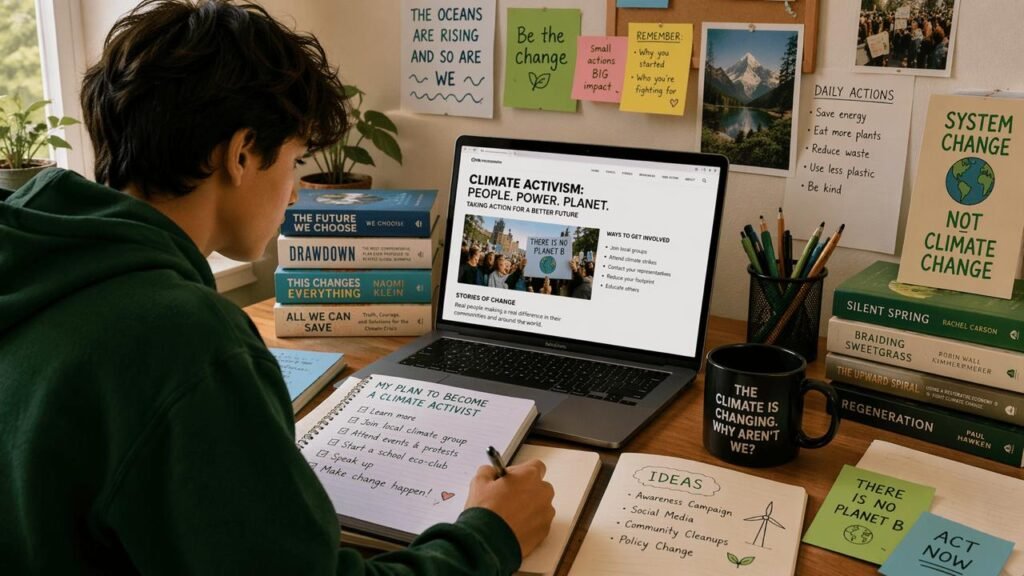
Young person at desk researching climate activism on laptop surrounded by environmental books and notes, planning their journey to become a climate activist.
You don’t wake up one day as a climate activist. You become one through a series of small decisions that gradually reshape how you spend your time, what you talk about, and where you direct your energy. If you’re reading this, wondering how to make that transformation, you’re already further along than you think. The distance between climate-concerned and climate-active is shorter than it appears, and this guide maps the path.
What Is a Climate Activist?
A climate activist is anyone who takes deliberate, organized action to address the climate crisis. This includes teachers integrating environmental education into their curriculum, tech workers advocating for corporate carbon neutrality, artists creating work about ecological loss, policy advocates pushing for clean energy legislation, and youth representatives traveling to 195 countries to document frontline climate stories. What transforms someone from a concerned citizen to a climate activist isn’t a dramatic moment… It’s the decision to shift from passive worry to active engagement.
What Are the Different Types of Climate Activists?
Before mapping your path into climate activism, it helps to understand the landscape. Climate activists operate across several distinct but overlapping categories, each requiring different skills and offering different entry points.
- Community organizers focus on grassroots mobilization, bringing people together for local environmental campaigns. They host meetings, coordinate volunteers, and build the social infrastructure that sustains movements over time. If you naturally connect people together and enjoy event planning, community organizing might be your lane.
- Policy advocates work within governmental and institutional systems to push for climate legislation and regulatory change. They attend city council meetings, lobby elected officials, submit public comments on environmental policies, and translate complex policy into language that mobilizes public support.
- Direct action participants take part in climate events and community forums that demonstrate broad public demand for action. Their visible presence creates the mandate that makes policy change politically viable, from Fridays for Future gatherings to organized campaigns that hold institutions accountable.
- Climate educators share knowledge about climate science, solutions, and justice through teaching, content creation, public speaking, and workshop facilitation. Writers, teachers, and documentary filmmakers often fall into this category.
- Innovation activists drive climate solutions through technology, business, and systems design, developing renewable energy projects, creating sustainable products, and proving that climate action can be economically viable.
- Workplace activists organize within their existing jobs to push employers toward climate accountability, advocating for carbon neutrality commitments, renewable energy transitions, and sustainable supply chains.
Most effective activists blend several approaches based on their skills and circumstances. Find the ones that fit your life rather than forcing yourself into approaches that don’t.
Step 1: Find Climate Activist Role Models (But Don’t Try to Be Them)
Role models serve two functions: they prove meaningful impact is possible, and they offer tactical inspiration you can adapt to your own circumstances.
- Greta Thunberg, now 23, remains the most recognized climate activist globally. Starting her solo school strike in 2018 at age 15, she catalyzed the Fridays for Future movement that brought millions of young people into climate activism. Her accomplishments include addressing the UN Climate Action Summit, meeting with heads of state, being named Time Person of the Year in 2019, speaking at Davos, and fundamentally shifting how global media covers youth climate voices.
- Vanessa Nakate from Uganda founded the Rise Up Movement and uses her platform to amplify frontline climate stories from communities often overlooked in Western media. At 29, she demonstrates how activists can center marginalized perspectives while building international influence.
- Xiye Bastida, a 23-year-old Mexican-Chilean activist, co-founded the Re-Earth Initiative and emphasizes the intersection of Indigenous wisdom and contemporary climate science.
- Johann Hoschtialek, founder of 195in365, offers another model entirely: a father concerned about his children’s future who’s building a global youth movement by visiting all 195 countries in 365 days. His path looks nothing like Greta’s, and that’s precisely why it works.
Study these activists’ approaches. Notice how they frame issues, build coalitions, and sustain momentum over years. Then resist the urge to replicate their paths exactly. The most effective activists emerge from their unique context and circumstances. You don’t need to become the next Greta Thunberg. You need to become the first version of your activist self.
Step 2: Educate Yourself (But Set a Deadline)
Effective climate activism requires understanding the science behind the crisis. Start with authoritative sources: IPCC assessment reports, NASA’s climate change portal, and peer-reviewed journals like Nature Climate Change.
Here’s the trap that snares many would-be activists: education can become procrastination. Give yourself a realistic deadline: two to four weeks to build foundational climate literacy. Learn the basics of greenhouse gas emissions, feedback loops, tipping points, and solution pathways. Then stop consuming and start creating change.
Give yourself a realistic deadline: two to four weeks to build foundational climate literacy. Learn the basics of greenhouse gas emissions, feedback loops, tipping points, and solution pathways. Understand the difference between mitigation and adaptation. Grasp why climate justice matters and how climate change intersects with existing inequalities. Then stop consuming and start creating change.
You’re not required to be a climate scientist. When you encounter questions beyond your knowledge, say, “I don’t know, but here’s where we can find reliable information together.” Authenticity often proves more persuasive than encyclopedic knowledge.
Step 3: Can You Make a Living as a Climate Activist?
This is the question people ask privately but rarely address publicly: Do environmental activists get paid? The answer is nuanced and worth understanding before you commit.
Yes, paid positions in climate work exist. Environmental NGOs like Greenpeace, 350.org, WWF, and the Sierra Club employ staff at various levels; entry-level community organizing and communications roles often start around $35,000–$50,000 annually, while senior campaign directors can reach $60,000–$100,000 or more. Policy advocates and climate lobbyists working for well-funded organizations earn between $50,000–$90,000. Climate communications specialists earn $45,000–$80,000 and are increasingly in demand. The renewable energy sector offers the most financially stable climate-adjacent careers, from installation technicians to project managers.
The reality for most climate activists looks different: most begin as volunteers and transition into paid roles as they prove their value. Many maintain day jobs entirely separate from their activism. You don’t have to choose between passion and paycheck. The steps below show how.
From Knowledge to Action: Your Next Steps
Bring It to Your Workplace or Campus
You don’t have to quit your job to become a climate activist. One of the most powerful forms of activism happens within existing workplaces. Through initiatives like the Employee Climate Action Network, you can organize with colleagues to push your employer toward greater climate accountability, advocating for carbon neutrality commitments, renewable energy transitions, or simply running “lunch and learn” sessions that build climate awareness.
The same applies to students. Campus climate groups have historically been at the forefront of environmental movements. Start by recruiting 3–5 committed peers, identify a supportive faculty advisor, and begin with a sustainability audit to find where your institution can reduce its environmental impact. Early wins build momentum and attract new members.
Find Your Local Entry Point
Searching “climate action near me” reveals opportunities you might not know existed. Local chapters of 350.org, the Sierra Club, and the Climate Action Network organize campaigns tailored to regional environmental issues. Universities often host environmental groups open to community members. Town halls on environmental policy offer direct access to decision-makers, and attending just one connects you to a network that enables more ambitious engagement later.
Take Your First Public Action
This is the moment that separates climate-concerned from climate-active: taking public action that makes your engagement visible beyond private conversations.
Public action comes in many forms. It might mean speaking at a school board or town hall meeting about climate education or policy. It could be writing and submitting a letter to the editor of your local newspaper. It might involve organizing a small documentary screening for ten people, creating and sharing climate content online, or attending a Fridays for Future gathering in your city.
The psychological shift that comes with public action is profound. When you move from “I privately care about climate” to “I publicly work on climate solutions,” you claim an identity as an activist, and that identity shapes everything that follows.
Join a Global Movement Like 195in365
For those aged 18–30 seeking an immersive climate activism experience that combines education, action, and international community, 195in365 offers a unique opportunity. This global youth-led movement brings together representatives from 195 countries for a year-long journey to every nation on Earth, meeting frontline communities, documenting environmental challenges and solutions, and building the global network that tomorrow’s climate leadership will depend on.
Participants receive training in sustainable activism practices, climate science, and cross-cultural collaboration. The movement practices what it advocates, prioritizing renewable energy in its logistics and maintaining a net-zero carbon footprint goal.
Learn more and apply: 195in365.com/global-volunteer-application/
The Path Forward
The climate movement doesn’t need more people waiting for perfect clarity before they act. It needs people willing to start with uncertainty, learn through doing, and adapt as they grow. It needs your particular combination of skills, experiences, and perspectives, not despite your unique circumstances, but because of them.
Your next step might be attending one local climate event this month, reaching out to one organization with specific skills, or applying to join a global movement like 195in365. Whatever your next step, take it soon. The climate crisis isn’t waiting for you to feel ready. The good news is, you’re ready enough right now: Apply to join 195in365 and represent your country in the global climate movement
New to climate activism? Start with the basics: Climate Activism: 7 Ways to Get Involved Today
Frequently Asked Questions About Becoming a Climate Activist
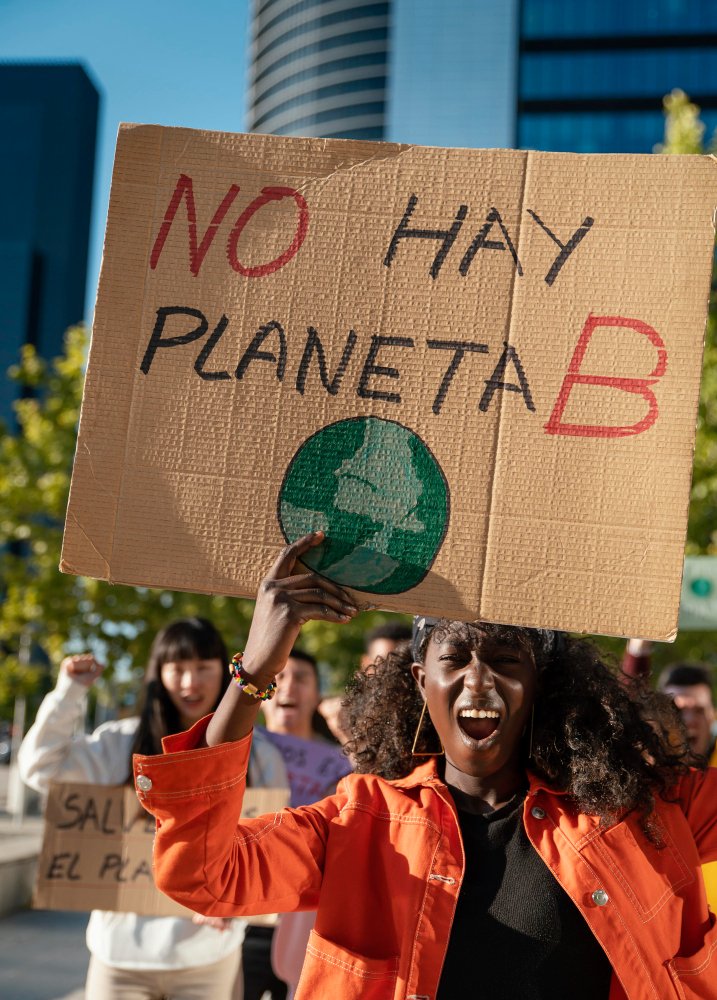
A climate activist is anyone who takes deliberate, organized action to address the climate crisis. This includes community organizers, policy advocates, educators, workplace organizers, and participants in global movements like 195in365. You don’t need formal qualifications or prior experience; what defines an activist is the decision to shift from passive concern to active engagement.
Greta Thunberg is the most globally recognized climate activist, known for founding the Fridays for Future school strike movement and addressing world leaders at the UN and COP conferences. Other prominent figures include Vanessa Nakate (Uganda), Xiye Bastida (Mexico-Chile), Vanessa Gray, and Johann Hoschtialek (founder of 195in365). Famous organizations include 350.org, Greenpeace, and the Sierra Club.
Climate activists work across six overlapping categories: community organizers who build grassroots movements, policy advocates who push for legislative change, direct action participants who make public demand visible, climate educators who teach and create content, innovation activists who develop sustainable technologies and business models, and workplace activists who organize within their employers for climate accountability. Most effective activists blend multiple approaches based on their skills and circumstances.
Yes, paid positions in climate work exist across environmental NGOs, policy organizations, the renewable energy sector, and corporate sustainability departments. Entry-level roles often start around $35,000–$50,000, while senior positions can reach $60,000–$100,000+. Most activists begin as volunteers and transition into paid work over time. Many also maintain separate employment and contribute to climate causes through volunteer engagement or workplace activism.
Yes, and workplace activism is one of the most impactful models available. Through initiatives like the Employee Climate Action Network, you can organize within your existing job to push your employer toward greater climate accountability without sacrificing income or career stability. Teachers integrate climate education, tech workers pressure companies on carbon commitments; finance professionals advocate for fossil fuel divestment. You don’t have to choose between financial security and climate engagement.
About the Author.
David Bartos is a ghostwriter and SEO strategist specializing in Sustainability AI. He partners with climate-focused founders and organizations to turn their mission into visibility, translating urgent environmental work into written content that resonates and ranks to help drive action.